Welcome To My Blog |
|
Welcome To My Blog |
|
|
Have you ever used GPS to help you find your way to a particular destination? I do this quite often when travelling to places I don't know very well. It's convenient to enter an address, follow the directions, and let the technology guide you. However, I've noticed something interesting when using GPS. If I decide to take a different turn because I know the area or think I have found a better route, I hear that familiar message: "Recalculating." That's not necessarily a problem if I'm simply listening to the directions. I can continue driving while the GPS works out a new route. But if I need to keep looking at an online map on my screen to figure out where I am going, it can become a distraction. I would much rather have a good understanding of where I am and where I need to go without constantly checking a screen.  What Can We Learn from The Amazing Race?I enjoy watching The Amazing Race. One of the things I find interesting is how the contestants have to find their way from one destination to another, often in places they have never visited before. They don't always have access to electronic devices to help them navigate while travelling between locations. They need to know how to read a paper road map, recognize place names, follow routes, and figure out which direction they need to go. Sometimes they can ask local people for directions, but that doesn't always guarantee they will arrive at the right place! If they make a wrong turn, there isn't a friendly voice telling them "Recalculating" and providing a new route. They have to work out where they went wrong and decide how to get back on track. Sometimes they end up quite lost! Watching the contestants reminds me that knowing how to read a map is still a valuable skill. Technology can certainly make travelling easier, but understanding how to interpret a map gives us another way to find our way around.  image from the Amazing Race Facebook page Maps Are Useful in More Places Than We ThinkYou don't need to travel to an unfamiliar city to need a map. Every summer, my family goes camping. When we arrive at a campground, we usually get a map showing the layout of the area. I always make sure I have that map with me! There are often quite a few things to locate. We need to find our campsite, but we also want to know where the washrooms, playground, office, and other activity areas are. Depending on the campground, there might be a lake or river, walking trails, picnic areas, or other places we want to explore. The map helps us see where everything is located in relation to our campsite. I carry it around so I can check where I am going and avoid getting turned around when heading to a different area. The same thing applies when exploring hiking trails, parks, or other unfamiliar places. A trail map can show us where we are, which paths we can follow, where different trails meet, and what landmarks or features we might encounter along the way. These are everyday examples of how maps help us understand the area around us. They give us information that we can use to make decisions about where to go and how to get there.  Why Do Children Need to Learn Map-Reading Skills?Children see adults using phones and GPS devices, so they may assume finding a location is simply a matter of entering an address and following directions. But children don't automatically know how to interpret a map. A map is more than a picture of a place. It contains information that helps us understand locations and how they relate to one another. They need opportunities to learn what the different parts mean and how to use the information provided.  When children learn to read maps, they begin to develop several important skills:
 Understanding Symbols and LegendsOne of the first things children need to learn is that maps use symbols to represent real things. Think about a campground map. It might use a small picture of a tent or numbered spaces to show campsites, a building to identify washrooms, and a swing or slide to indicate the playground. A blue line might represent a stream, while a larger blue area could show a lake. But how do we know what each symbol means? That's where the legend, sometimes called a map key, comes in. It explains the symbols used on the map so that anyone looking at it can understand the information.  Children need practice recognizing these symbols and using the legend to find information. You can begin with a simple map of a familiar place and ask questions such as: Can you find the playground? Which symbol represents the washrooms? Where is the entrance? How would you get from the office to the campsite? Which features are closest to the lake? As children become more familiar with maps, they can begin using legends and symbols on road maps, community maps, and maps showing larger geographical areas. Understanding these symbols helps children make sense of the information rather than simply looking at the pictures. Helping Children Become Comfortable Using MapsWe don't need to wait until children are older to introduce map-reading skills. We can begin with familiar places and gradually introduce more information as they develop their understanding. A simple map of the classroom or schoolyard can be a good starting point. Children can look for familiar features, recognize symbols, and talk about where things are located. From there, we can introduce maps of the neighborhood, community, and places they might visit with their families. The important thing is to give children opportunities to use maps for a purpose. They need to see that maps provide information that helps them understand their surroundings and make decisions. This free booklet helps kids to use some of the skills they learn to create a neighborhood map. 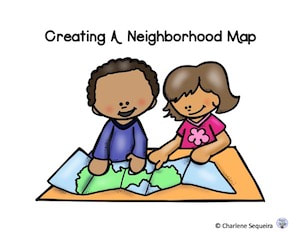 In a world where technology is constantly changing, knowing how to read a paper map is still a useful skill. It gives children another way to navigate their surroundings and helps them develop a better understanding of the world around them. And who knows? Those map-reading skills might even come in handy one day if they decide to compete in The Amazing Race!    Related Posts Comments are closed.
|
About Me Charlene Sequeira
I am a wife, mother of 4, grandmother of 9, and a retired primary and music teacher. I love working with kids and continue to volunteer at school and teach ukulele. 
Categories
All
|
 RSS Feed