Welcome To My Blog |
|
Welcome To My Blog |
|
|
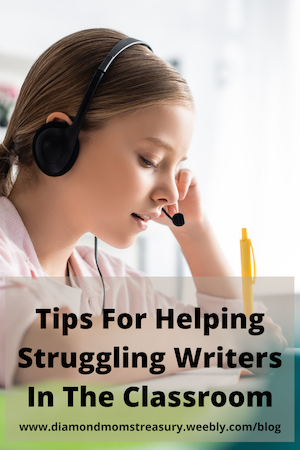
Have you ever had kids that just couldn't seem to get started writing or who would only write very basic sentences? The struggle to write descriptively is real for many younger children. They have limited experience with writing and often need support to get started. Here are 7 tips that may help to open the flood gates and get the ideas pouring onto the page.  1. Start with telling stories orallyKids love to share their stories and adventures with others. They often get very excited when they have ideas to share and they are eager to go into great detail if others ask questions and want to know more. Using this idea and explaining that writing descriptive stories is just putting down on paper what they would share when telling someone a story may help them to get started. Perhaps they could imagine questions that others might ask and make some notes of these and the answers to use as they start their writing.  2. Use the five sensesOne of the things that I found worked well with my students was finding words that fit the five senses. Using colors, shapes, textures, sizes, sounds, smells, and tastes are just some of the ways they can describe what is happening. I created some graphics and examples to help them see this in action. Check them out here.  3. Paint a picture for the readerUsing paintbrushes to create a picture is another tool that I used for my students that helped them to think of descriptive words. I would ask them to imagine that someone wasn't able to see an object. Then I would say, "How could you describe it so that they could get a really clear picture in their mind?" This helped them to think about different types of adjectives, and actions that could make the picture come to life. 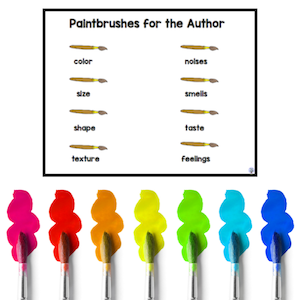 4. Ideas first, conventional spelling laterMany kids are afraid to write because they don't know how to spell certain words. If they don't take a chance and get their ideas down on paper because they are afraid of spelling words wrong, nobody benefits. I believe it is important to get ideas down first and worry about correcting spelling later. Often the invented spelling is close and the stories are still readable. If the invented spelling is way off, it may be necessary to help with some of the words to help the story make sense, but nothing turns a person off more than a page full of corrections. It is important to validate the effort and then choose when to do a published copy with corrected spelling. Treat the initial writing as a draft that may or may not go to published format. 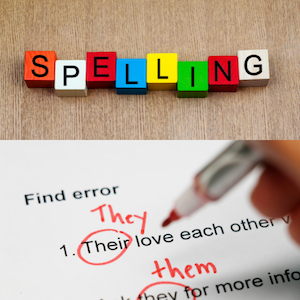 5. Choose topics for writingIf kids have a choice of what to write about, they still need to have some ideas to choose from. I use a heart that is divided in many sections and I get them to write down things they enjoy or that they are passionate about. I actually give them 2 identical hearts so that they can draw on one and write words to go along with the images on the other one. These hearts are kept in their writing book so they always have a list of go to ideas. 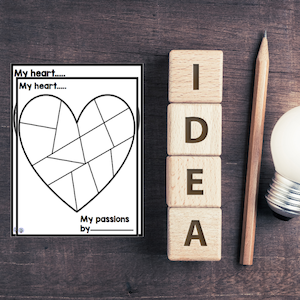 6. Do some examples togetherHaving an example to follow will help some kids get started. Here is one that I often used. The cat sat. The cat sat on the mat. The brown and white cat sat on the mat. The soft brown and white cat sat on the mat. The soft brown and white cat sprawled on the mat. The soft brown and white cat sprawled on the welcome mat. i could keep going, but I think you get the idea. 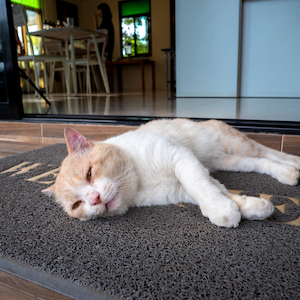 Provide a checklist and criteriaIf you are planning on grading the students' work, it is important to provide a checklist or criteria so that they know what is expected of them. There are many different checklists and rubrics available. Here is a checklist that could be used for primary students. 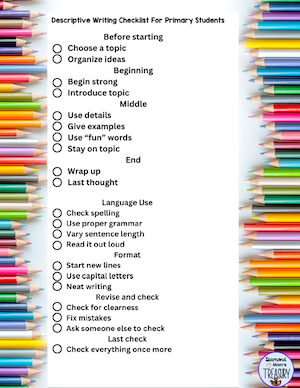 Descriptive writing takes time for many students, but if they are given lots of opportunities to write, it will improve. I hope these tips help to open those flood gates for your students.   Related Posts
If you want excitement, watch how kids react to the first sign of snow. When I woke up a few days ago, there was a light dusting of snow on the ground. Little did I know when I headed to school, it would be a few inches by lunch time. The kids kept looking out the window and watching the clock waiting for recess break so they could get outside and play. Of course this meant allowing more time for bundling up and preparing to go outside, then unbundling and dealing with snowy gear when they came back inside, as well as the many stories they had to tell about playing in the snow. 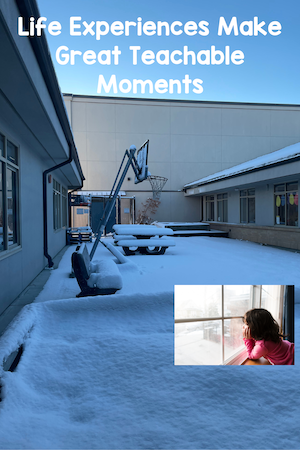 Teachable MomentsTeachable moments are rampant at times like this. I like to use these events as springboards into different activities. You can still meet requirements of the curriculum by adding them in, they just have a fun twist to capture the excitement and focus of the kids. I learned early on to take advantage of this excitement instead of trying to squash it so that they could get back to work. Here are a few different ideas that I would do. Story telling and writingI would build in time to allow them to share their stories and then I would use that to help them write stories. Story writing using the fun activities they did outside can help even the most hesitant writer to put pen to paper. 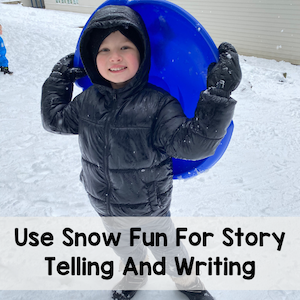 Once I had my class imagine what it would be like if the city froze. We talked about all kinds of crazy scenarios and possibilities and after brainstorming as a group, each person did some more brainstorming on their own. Then, they wrote stories and tried to add in many details and descriptive words to paint the picture in the reader's mind. Sharing the stories later was so much fun. Here is the template we used for the stories. 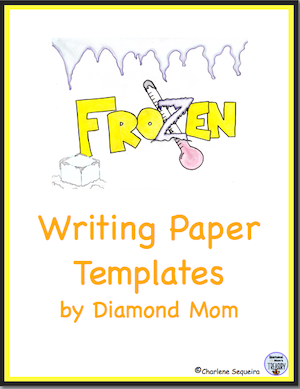 Grab a free copy of Frozen templates by subscribing to my newsletter. Math And Science ActivitiesSometimes, I would take a math or science approach. This might include measuring the snow, seeing how long it takes to melt when brought inside, building a fort outside, seeing who can throw a snowball the farthest, making snow families, or checking the temperature at different times of the day to see if it gets colder or warmer. 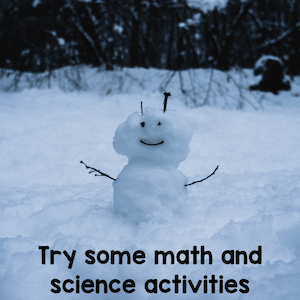 Snow AlternativesIf you live in a place that doesn't get snow, you could try doing some activities that might mimic those we did. For example: Use rolled up socks as pretend snowballs and see who can throw them the farthest. Shave up some ice and form snowballs and try to make a small snowman. Use ice cubes to build small forts Check the temperatures in different parts of the world for a few days in a row and then graph the results. Imagine what a snow day would be like and write about it. 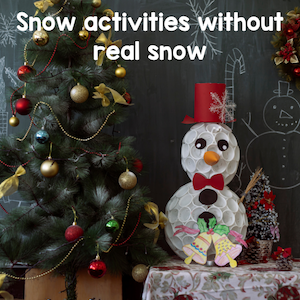 There are several winter language and math activities that you can do, but adding in the real life moments just makes them so much more fun. Here are some other winter resources that might be of interest as the cold, white days continue. Winter Sports Bundle Winter Word Work Language Activities Winter Parts Of Speech Silly Sentences For lots more ideas, check out my winter math and literacy category.  Winter novel studies are also a great way to include a winter theme into your language arts. Here are some novel studies that might interest you. Emma's Magic Winter The Kids In Ms. Coleman's Class - Snow War Stone Fox Horrible Harry And The Holidaze  Grab the excitement and wonder of winter and add it to your lessons for more engagement and motivation. I would love to hear some of the other ways you weave winter into your lessons. Don't forget to grab your free copy of Frozen writing templates.  Related Posts
Animals are fascinating creatures and kids love to learn about them and their life cycles. They are in awe from the moment of their births and they marvel at the ways they grow and change.  What is a life cycle?Every animal on Earth has a life cycle - this is the process they go through from when they're born until they die. All animals have different life cycles, and the length of time it takes them to go through each stage varies hugely too. Let's take a look at some examples. A frog's life cycle has four stages: egg, tadpole, juvenile, and adult. Frogs start their lives as eggs, which are laid in water. Once they hatch, they grow into tadpoles, which have tails and live in water. As they mature, they develop legs and lose their tails, becoming juveniles. Eventually, they turn into adults and leave the water for good. Honey bees have a very different life cycle to frogs. They have three stages: larva, pupa, and adult. Honey bee larvae hatch from eggs and are fed by the worker bees. After a few weeks, they enter the pupa stage. During this stage, their bodies change and they develop into adults. Once they emerge they take on their roles of worker bees, drones, or queen bees. 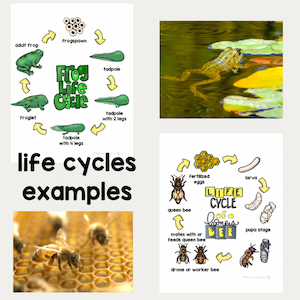 Mammals life cycleThe animal life cycle that is probably the most familiar to us is the one we see in mammals. Mammals generally go through four distinct stages in their lives-embryo, neonate, juvenile, and adult. As human mammals, we can relate to these. When a woman is pregnant, the baby is in the embryo stage. This is the time from when the egg is fertilized by the male until the baby is born. When the baby is born, it needs to be cared for by the parents because it is not able to care for itself yet. This is the neonate stage. As the child becomes more independent and able to care for itself, we refer to this as adolescence or the juvenile stage. When the child has reached full maturity and can mate and have offspring of its own we refer to this as the adult stage. 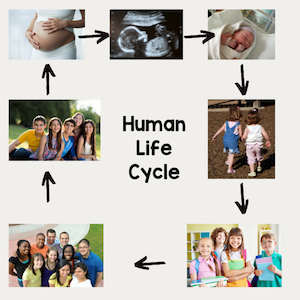 Life cycles in the classroomIn many primary classrooms, at some time during the year you will find a life cycle of some animal being studied. At my school, this was usually butterflies, chickens, or salmon. Not only were the students in the class excited to see the changes from eggs through the stages as they became these different animals, other students around the school would often stop by to check out the changes too. There is no better way to learn than to experience it in person. Learning from videos, books, or shared experiences of others is okay, but seeing that butterfly emerge from its chrysalis, watching that baby chick peck it way out of the egg or releasing fry into the river will imprint that memory for years to come. 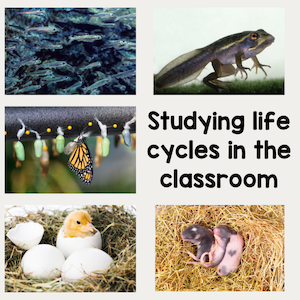 If you are interested in studying the life cycles of animals with your class, here are some resources that I have created that might help. Life cycle of a salmon Life cycle of a frog Life cycle of a chicken Life cycle of a honey bee Life cycle of a butterfly 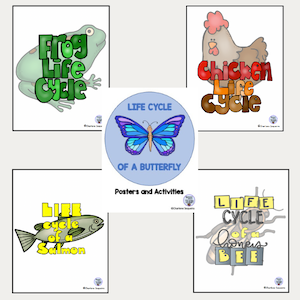 Here is a set of templates that may be helpful for gathering information about animal life cycles. It is part of a set of 4 animal research templates. Grab your free copy by subscribing to my newsletter. 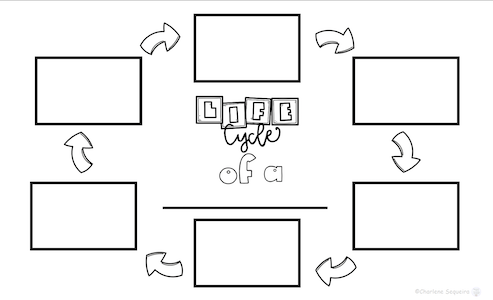  Related Posts
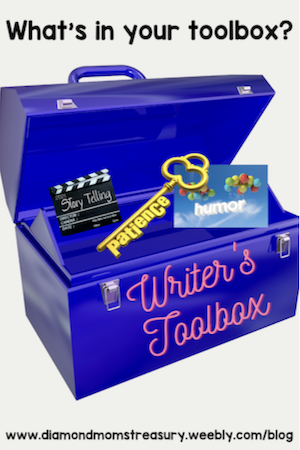
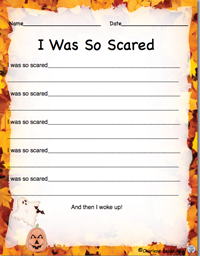
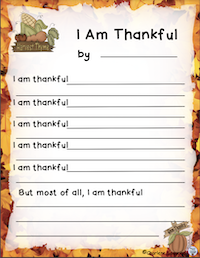
When it comes to teaching beginning young writers, there are a few essential tools that every teacher needs in their toolbox. What's in your toolbox?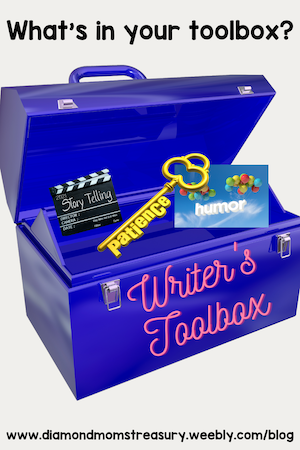 1. Patience First and foremost, patience is key. It can be frustrating for beginning writers when their ideas don't always come out perfectly on paper, but it's important to remember that they're still learning and growing. Try to provide encouragement and positive feedback whenever possible. 2. Sense of humor Secondly, a good sense of humor can go a long way. When beginning writers make mistakes, try to see the humor in it and help them to see the silver lining. 3. Story telling Lastly, story telling is a great tool for beginning writers. By providing examples of stories that have been successfully written, beginning writers can see what is possible and be inspired to create their own masterpiece. With these tools in your toolbox, you'll be well on your way to teaching beginning young writers. Tips for getting started There's nothing more rewarding than seeing a beginning young writer find their voice. But getting started can be tough. That's why I always tell my students that the best way to become a better writer is to write every day, even if it's just for a few minutes. One of the best ways to get started is to keep a journal. Write about anything and everything - what you did today, what you're thinking about, what you're feeling. It doesn't have to be perfect, and no one else has to read it. Just getting your thoughts down on paper can help you to clear your head and see things in a new light.  Another great tip for beginning writers is to read as much as you can. Not only will this help to improve your writing skills, but you'll also get some great ideas for things to write about. So go ahead and crack open a book (or two, or three!) and start exploring the world of writing today. 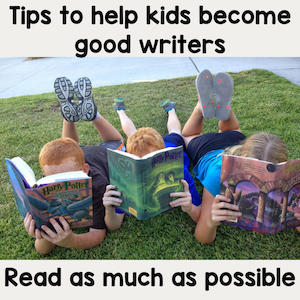 Remember that every writer has to start somewhere. So don't expect perfection from the beginning. Just encourage them to get their thoughts down on paper, and worry about editing later. I often tell my students to use approximations to get their ideas out, and then find the "dictionary spelling" when they are ready to polish their work. If they fret too much about correct spelling, the stories will never be as developed and wonderful as they could be. Use scaffolds and graphic organizers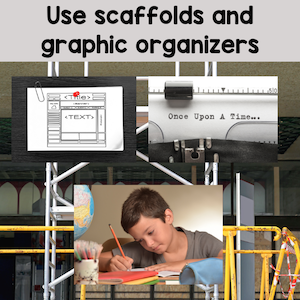 Scaffolds and graphic organizers can be extremely helpful for beginning writers. By providing a structure for their thoughts, beginning writers can more easily organize their ideas and put them into words. Scaffolds also help beginning writers to stay on track, keeping their focus on the task at hand. Graphic organizers can be used to plan out a story or to brainstorm ideas for an essay. They can also be used to keep track of characters and events in a story. By using scaffolds and graphic organizers, beginning writers can become more confident and proficient in their writing. Here are a couple of scaffolds that I have used successfully over the years for the fall.
If you would like a copy, click on the images.  Finally, be sure to offer plenty of compliments and encouragement along the way. Let them know that you're proud of their progress, and that you believe in their ability to become great writers.  Remember: With a little support and guidance, beginning writers can achieve anything.  Related Posts
There's nothing quite like the feeling of struggling to read or write. It can be frustrating, overwhelming, and even a little bit scary for kids. But there's hope! 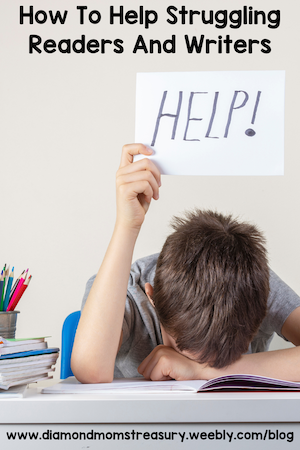 I often hear the question, "What can I do to help my struggling readers and writers?" While there is no one-size-fits-all answer to this question, there are a few strategies and activities that can be used to help struggling students. Supporting your studentsIf you have a wide range of reading abilities in your class, it is important that you find ways to support all your students in developing and expanding their skills and knowledge. One of the best ways to do this is to create reading groups of similar abilities so that you can target the instruction to the specific needs of each group. Note: There can be many high achieving readers and writers in the class, but for this post, I will be focusing on those who struggle.) 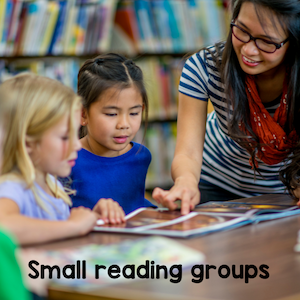 Ideas for struggling readersDo guided reading groups. This can be done with just a few students at a time, so everyone gets the individual attention they need. Choose books that are at the right level for each group, and then take turns reading aloud. As you read, stop and discuss vocabulary words or tricky concepts. This will help your students build their comprehension skills and confidence. Create some reading center activities that complement what is happening in the reading groups to help kids to remain engaged and motivated to keep trying. For example: 1. Provide a variety of books of a similar level for kids to choose to read quietly alone or with a partner. Make sure you have a variety of different genres of books for your struggling readers. This will help them find something that interests them and that they can read at their level. 2. Create word lists or anchor charts with high frequency words or sight words. The students can use the word lists to help them read the books. 3. Provide word games and activities that they can use to improve their decoding and fluency skills. Be sure to set realistic goals for struggling readers and help them celebrate their progress along the way. 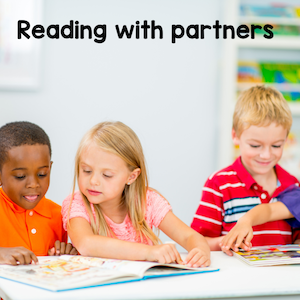 Ideas for struggling writersGetting started is one of the most difficult things for struggling writers. There may be a variety of different reasons for this, but it is a barrier that they need to get past in order to become good writers. Sometimes it is hard to come up with an idea, or maybe it is a fear of not knowing how to spell words, or maybe it is the motor skill of writing itself. These are only a few examples of things stopping the writing from happening. If we provide support to help with these roadblocks it is amazing what can happen with our struggling writers. Here are a few suggestions that might help our writers to get started. For those who have difficulty coming up with ideas1. Try using favorite interests, hobbies, events, or things that are important to them as starting points. Work on brainstorming ideas and organizing thoughts. 2. Encourage them to draw pictures or create a graphic organizer before actually writing. Provide a variety of different writing supports such as sentence starters, word banks, scaffolds, templates or prompts to support getting their ideas down on paper. 3.Encourage them to write for 20 minutes each day and help them brainstorm ideas for stories or poems. Give struggling writers plenty of opportunities to practice writing, whether it's through daily journaling or regular writing assignments.  For those who worry about correct spelling1. Provide word banks or word lists and dictionaries. 2. Encourage them to use approximations to get their ideas down and then go back and check for the "dictionary spelling". (It is important to get the ideas out first and then edit.) 3. Have someone scribe for them at first and gradually get them to write on their own. Don't forget to provide plenty of praise and encouragement! 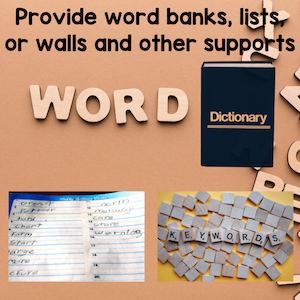 For those who have motor issues1. Create an area with paper, pencils, and crayons. The students can practice writing their names, letters, and words. They can also draw pictures and tell stories. These activities will help the struggling writers to develop their skills. 2. Set up a dictation area where they can orally tell their stories and then have them transcribed. 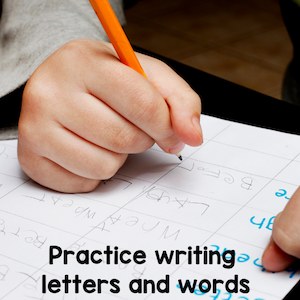 Set up a writing centerEstablish a writing center where struggling writers can go to work on their skills. Here they can work on different writing strategies. They might work on brainstorming ideas, organizing their thoughts, or using descriptive language. They might work on specific writing goals with your guidance. For example, you might have a student who is working on adding more detail to their writing. Give them some sentence starters that they can use, and then have them add as much detail as they can. Alternatively, you might have a student who is working on editing their work for grammar mistakes. Give them a list of common mistakes to look for, and then have them edit their own work or someone else's. Writing centers are flexible, so you can tailor them to meet the needs of your students. Help struggling writers set realistic goals and celebrate their progress along the way. Be sure to praise their efforts and provide specific feedback on their work. 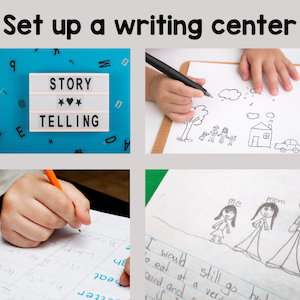 Assess how they are doingFinally, make sure you have a plan for monitoring the progress of your struggling readers and writers. This will help you know if they are making progress and where they need additional support. By taking these steps, you can help struggling readers and writers get the support they need to be successful in your class.  Organizing reading and writing groups can seem daunting, but it's worth it! Your struggling students will benefit from the extra attention and support. And who knows - you might just see some strong readers and writers emerge. 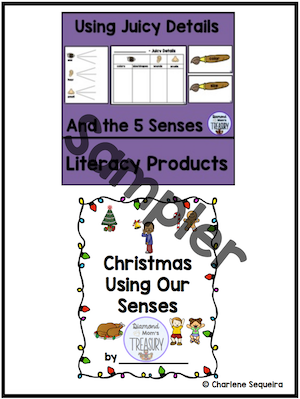 Grab a free copy of this set of templates and scaffolds for your young writers by signing up for my newsletter.  Related Posts
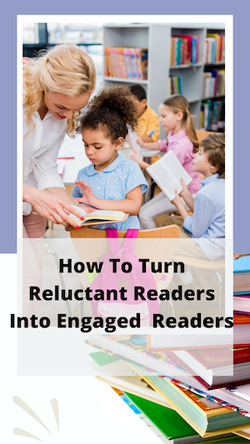
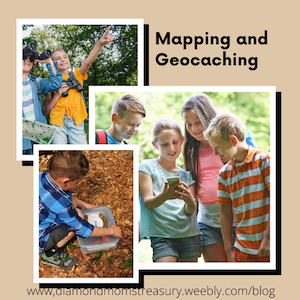
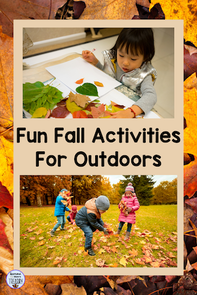
Round Up Of Tips, Ideas, And ActivitiesDuring the summer, there are lots of opportunities to do activities that blend academics and fun. This helps kids to practice and maintain concepts and skills already covered and also gives them chances to see how these concepts matter in real life. Here is a round up of different tips, ideas and activities that I have shared in the past that I feel are still relevant and worth revisiting. 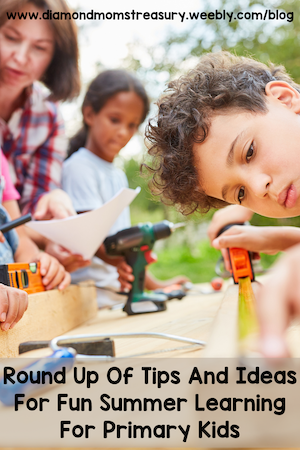 Math is often thought of as lots of calculations, worksheets, equations and critical thinking activities, but in fact, math is used in almost every decision and action that we make on a daily basis. Math is everywhere around you. We use math for most activities without even realizing it. In my blog post Tips For School And Home:How To Help Primary Kids With Math, I suggested a few different activities for sorting and classifying, measurement, estimation, time, geometry, fractions, and basic operations. In Math Real Life Activities For Children I talk about math in the kitchen, math in the workshop, shopping and math, and working with money. These are only a few ways that math can be connected to real life situations at home as well as at school. 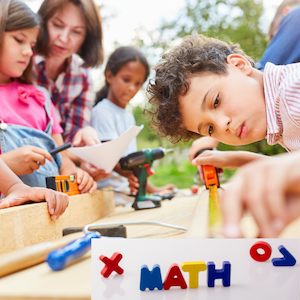 Language Arts - Reading and writing are only a couple of the components of language arts. In my blog post Tips For School And Home: How To Help Kids With Language Arts, I share several different suggestions and activities for the various aspects of language arts. It is important to note that language development starts at home and then is refined at school. There are many different ways to promote language development with reading, writing, and oral communication activities. I shared ideas and resources for phonics and vocabulary development, reading, writing, and oral communication in the above mentioned post. If you are looking for more ideas that will help with reading and writing for students that struggle in these areas, check out the following posts: Motivatiing Reluctant Readers Tips For Helping Struggling Writers In The Classroom 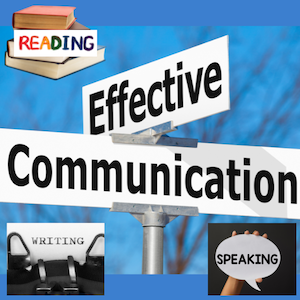 Just take a look around you and think about the various things you see and the things you do and if you start to analyze them, you will be amazed at how they involve science. Science is involved in every aspect of our lives. At school, kids are introduced to some of the basics, and various experiments and investigations are done. At home, more of these types of activities can happen and deeper learning can be accomplished. In my blog post, Tips For School And Home: How To Help Kids With Science, I break science down into different categories to help with providing a broad glimpse into the world of science. Hopefully, this will inspire kids to look further and continue to learn about the marvels around them. You will find some tips and ideas for chemistry, biology and life sciences, earth science, and several different areas of physics. Science Ideas For School And Home also gives some more ideas and possible activities that might be fun to try. 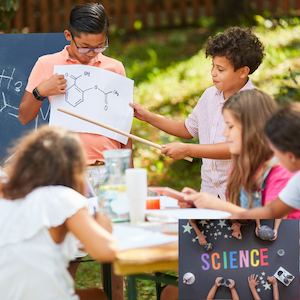 Social Studies is the study of people and their relationships to other people and the world. For young children, it starts with family and then spreads out to community, regions, provinces, states, or territories, and from there, to countries and the world. It can be broken up into 5 different categories: geography, history, culture and society, civics and government, and economics. I wrote 2 posts last year because there was so much to cover. Tips For School And Home: How To Help Primary Kids With Social Studies talks about geography, history, and culture, heritage and traditions and gives some ideas and possible resources that might work. Tips For School And Home: How To Help Primary Kids With Social Studies Part 2 This blog post focuses on the rights and responsibilities of people and regional leaders, relationships between people and the environment, multicultural awareness and diversity, and the interactions of First Nations people and early settlers. Social Studies Ideas And Activities For Outdoors also provides some tips and activities for learning more about the area where we live and the surrounding environment. 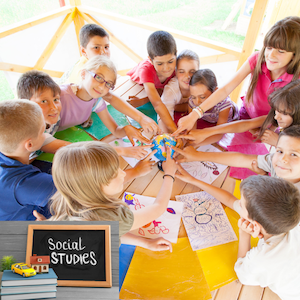 In my final instalment, Tips For Summer Support: How To Help Primary Kids, I focus on finding creative ways to do academic activities to make learning fun during the summer break. Well there you have a selection of tips and activities for the various academic areas that can be used to help kids keep learning throughout the summer while they are enjoying their holiday break.  I hope that these tips and ideas have given you some inspiration for ways to keep the learning going while having fun during the summer break.  Taking Learning OutdoorsSpring is just around the corner and along with it comes longer days, sunshine, fresh breezes, and early buds and blooms. What a great time to get outdoors with your students and take learning outside as well. 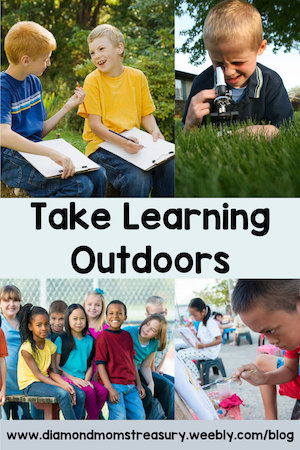 Ideas For Social Studies And Science OutdoorsThere are many different opportunities to cover academics outside and still enjoy the outdoors. Here are a few ideas that may help. For social studies, neighbourhood walks, checking out the community, following maps, doing geocaching and using coordinates are just a few things that can be done. If you want more information, check out my post about social studies outdoors. For science, you can do experiments such as coke and mentos to check out chemical reactions, the clink clunk test to investigate gravity, or do things to check out nature. Starting a garden, growing plants in pots and following their growth, taking a walk in the park or the forest, if you live near one, or visiting the seashore if you live near the ocean are just a few ideas. Kids love to interact with nature and they learn many life skills that they can use later on as well. 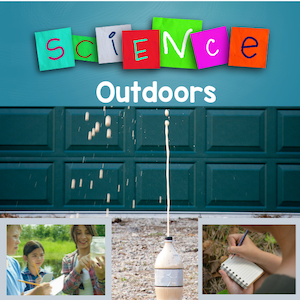 Reading and Writing Ideas For OutdoorsFor reading and writing there are many different options to try. Reading can be done in the environment by checking out signs, reading books with buddies while enjoying the sunshine, and playing games like Scoot for sight words are just a few ideas. During the warmer weather, we would often take our books outside for silent reading and find a quiet spot on the hillside at the edge of the playground to do our reading. One of my favorite activities for writing is to go outside and explore our senses. After making a list of different things for each of the senses, we use these ideas to develop stories. We choose a theme and use the list to create a descriptive story. My descriptive writing templates were developed for this. 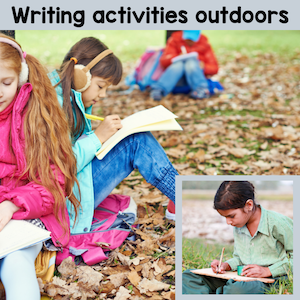 Math Ideas For OutdoorsFor math, the outdoors is a great place to work on measurement activities. You can do activities that work with larger units such as meters or yards and you can do perimeter and area activities. Kids love using the trundle wheels and measurement tapes to measure the fields, buildings, and other objects. The information gathered outside can then be used for creating scaled diagrams on graph paper. 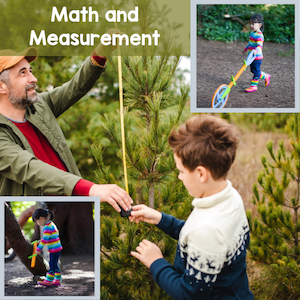 Taking Physical Activity And Gym Class OutdoorsTaking gym outside is an easy thing and I suspect is often done already. Many of the different sports can be done outside as well as inside. The fields and nearby parks are great open spaces for running activities, soccer, kickball, and games. Kids love being able to run around and get active without worrying about being too noisy. At my school, there is a courtyard and blacktop area with basketball hoops, tetherball, foursquare areas, or hopscotch games available. I liked using this for doing rotations of activities. Everyone could be doing activities at the same time instead of some people waiting for their turn. 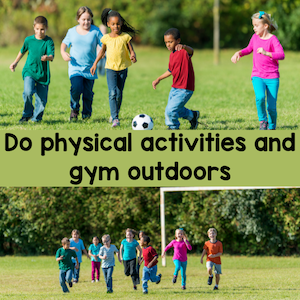 Try Music Games OutdoorsEven music class can go outdoors. I used to take my primary music classes outside to do circle games that require running and even rhythm games. One of my favorite rhythm games was a version of California kickball. Instead of just pitching the ball, I would clap out rhythms and they would have to say the rhythm correctly in order to get the ball thrown for them. 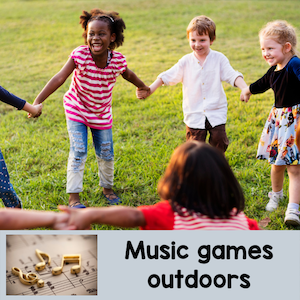 These are just a few examples of how you can take learning outdoors this spring. It really comes down to your own comfort and creativity. Enjoy the weather and have fun teaching outside. 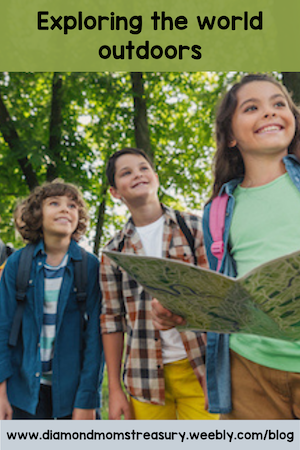  Related Posts
Helping kids expand their vocabularyAre you looking for ways to help kids with writing and sharing their ideas? This seems to be a common issue with younger children as they begin to share their ideas, but they don't have the words yet to describe things in detail. Instead, they tend to use the same few words over and over. We sometimes refer to these as "worn out words". 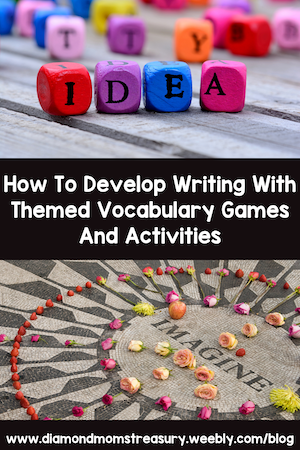 How to develop a rich vocabulary baseDeveloping a rich vocabulary base helps with writing and expressing ideas and it also allows kids to create more detailed and creative stories. There are many different ways to expand the vocabulary. Here are a few. Brainstorm as a classChoose some of the worn out words, such as nice, good, happy, fun and come up with a list of words that can be used instead. Try a thesaurusYounger children might find this a bit challenging, but they can still give it a try. A thesaurus will provide many synonyms for words. Do a vocabulary challengeTake a simple sentence and challenge the class to come up with different variations that make the sentence more interesting but still maintain the meaning. Then share the sentences with others. Create a themed word wallSometimes kids just need words that fit the various themes. They can help them to get their stories started or provide some extra ideas to expand their stories. A themed word wall can be changed as different themes are explored. If you don't want to devote space to an actual word wall, you can store the words on rings and allow the students to take them as needed to use. Use word games and activities to review vocabularyIt is important to make sure that the kids get lots of exposure to the words they need for various writing tasks. This ensures that the words become part of their working vocabulary. Then they will be able to access them more readily in future literacy situations. I find that word games and activities work well for working with vocabulary words as they are engaging and fun. Kids learn without realizing they are actually studying the words and phrases. The more they play, the faster they begin to recognize the words. Sight word games, silly sentences, I Have, Who Has? games, and task cards for matching games are a few examples that have worked well for me over the years. I created many of these games for literacy centers and they were always very popular. Using the same types of formats helps the children to focus on the content rather than how to play the games. Just change up the themes and let them play. 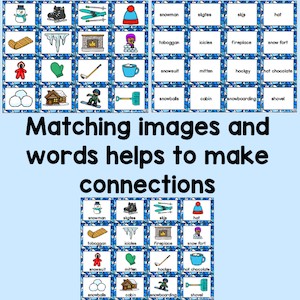 Here are some vocabulary word sets I created for the seasons and special days. I hope to be able to add to the special days in the future. There are sets of I Have, Who Has? cards for each of the seasons and special days as well. If you are teaching French, check out the French versions. 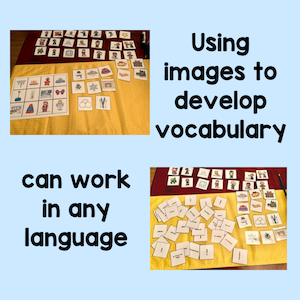 My students loved making silly sentences, so I created several themed sets for them. They enjoyed making the sentences and practiced parts of speech at the same time. As an extension activity, we would sometimes take the words and illustrate them and then put them into a flip book of silly sentences. You can check out my special days parts of speech silly sentences here. 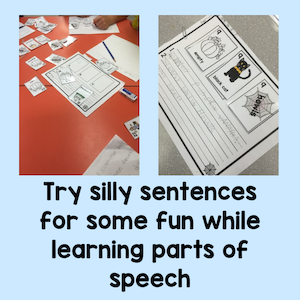 If you would like to try out a free vocabulary activity, sign up for my newsletter. I am offering my I Have, Who Has? Christmas set to my followers for free. 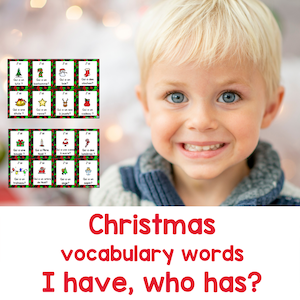 There you have some ideas for expanding and developing a broader vocabulary base for your students. I hope they work well for you. I would love to hear what other ways you use themed vocabulary in your classroom. Let me know in the comments. 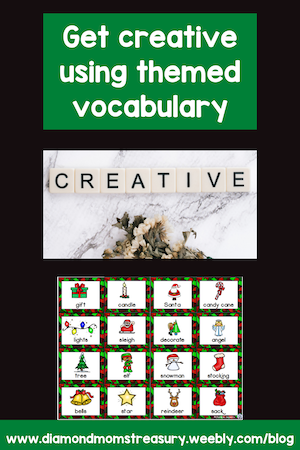  Related Posts
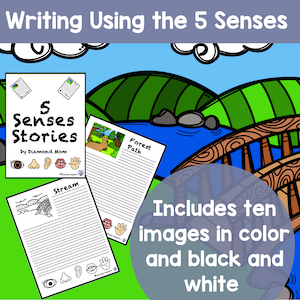
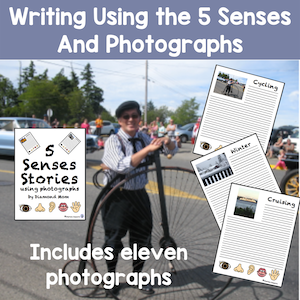
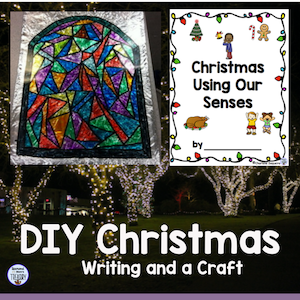
Capturing Imagination In WritingChristmas is fast approaching. This a time that is full of excitement and wonder and kids look forward to it all year. They start talking about it and making wishes. They enjoy getting gifts and being part of the decorating and family times. They have fun playing holiday games and activities at school. It is a great time to capture their imagination in their writing.  I used to tell my students to use descriptive writing with the five senses to paint a picture in the reader's mind. We would come up with lists of words and juicy details that would help to describe images. I even used paintbrushes as symbols for different types of descriptions. Check out my graphics and templates for this kind of detailed writing. Using images and graphic organizers can be really helpful for students that struggle with writing. They can even use them like a checklist as they get started. Eventually they will not need to rely on them anymore. 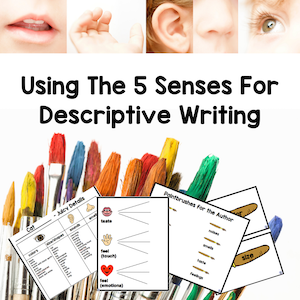 One of my favorite projects for this season is Christmas Writing Using The Five Senses. It is a poem that shares images from four different settings. I even shared it with another teacher and her class after I retired. We had fun working together and seeing the poems that the children wrote. 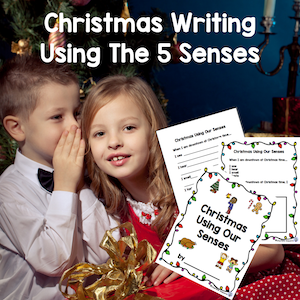 Here is one of the poems that a grade 2 student wrote. 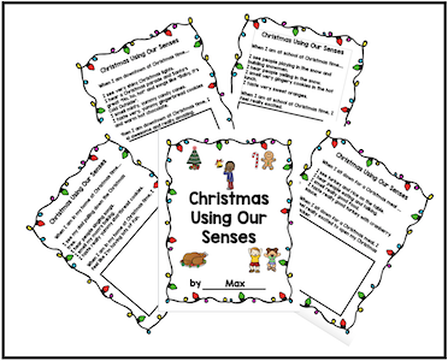 Another thing that we did was create a special craft to go along with the poem. You can check it out here. If you are interested in more writing ideas using the five senses, check out my products that use images and photographs to practice descriptive writing.
Grab this free sampler by signing up for my newsletter. Have fun watching your students create magical stories and poems this Christmas.   Related Posts
Week 1 Focus: Primary Language ArtsHome-school connections have been more important than ever this year because of the pandemic. It has also created some new and sometimes overwhelming situations for teachers, kids, and families as they have tried to navigate this new way of learning. For the next few weeks, I will be focusing on different subjects and providing teaching tips for school and home to support kids and parents. This week the focus is primary language arts. I will be providing teaching tips, activities and games to connect school instruction with real life experiences, and also some reasons that it is important to have this connection between school and home.  Language activities start at homeBeing able to communicate is important. This communication has many elements that are all included in language arts. Language arts includes reading, writing, oral communication, and language development. It is not just something that is taught and practiced at school. Children get their first exposure as babies and those that have a rich exposure to language when they are young have an advantage when they arrive at school. Family members are the first teachers of language arts. They introduce kids to oral communication, stories, and sometimes the start of written language. At school, teachers work with these beginning skills and help kids develop them.
Connecting school and home with real life activitiesAt school, children are introduced to the mechanics of language. They learn to recognize letters, use phonics to decode words, make sense of written language, start writing ideas down, do oral presentations, and develop a deeper understanding of these ways of communication. If they are able to connect these skills with real life activities at home their learning experiences will be enriched. There will be added benefits of quality family time and involvement.
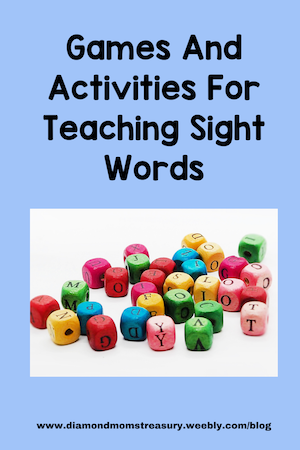
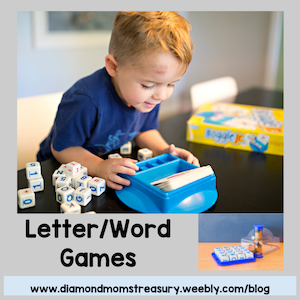
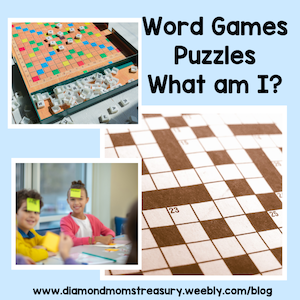
Activities and games to reinforce language skillsGames and activities are great ways to engage kids and help develop their skills. They have so much fun doing the activities, they don't realize that they are practicing the skills. Here are some suggestions that might be fun to try. (Some of these are products that I created. They are linked so you can check them out.) Phonics and Vocabulary Activities - sight word games - Boggle Jr. - Scrabble Jr. - Soundo games - Hangman - Word searches - Crossword puzzles - Vocabulary Mandalas - computer activities
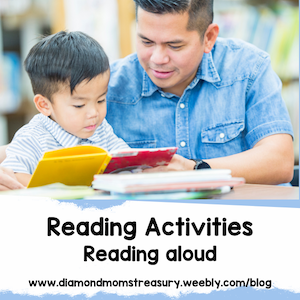
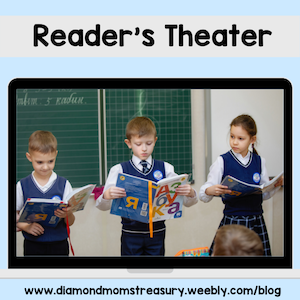
Reading Activities - Reading aloud/story time - Reader's theater - Re-enacting stories (example: Stone Soup) - Novel studies (example: Horrible Harry series) - Book review
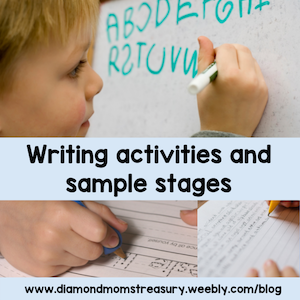
Writing Activities - poetry using nursery rhymes or songs (example: Orchestrating Writing Poetry) - 5 senses writing - using scaffolds - Mad Libs - Silly sentences (parts of speech) - keeping a journal or diary
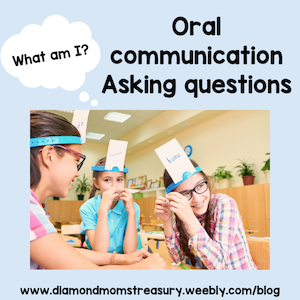
Oral Communication Activities - retelling stories - reading aloud and changing voices for different characters - reader's theater - discussions - interviews - listening to audiobooks
Teachers are willing to help support families as they provide everyday enrichment for the skills and concepts presented at school. It is important to remember that they may also have children at home that need that support and time, so we need to remember not to overwhelm them either. As teachers and families develop a connection, everyone will get through these challenging times. Remember: we are all cheerleaders for the kids. We want what is best for them and as we work together, they will succeed. I hope these tips are helpful as you navigate through the next few months. Next week I will be focusing on Math tips and activities.   Related Posts
|

About Me Charlene Sequeira
I am a wife, mother of 4, grandmother of 9, and a retired primary and music teacher. I love working with kids and continue to volunteer at school and teach ukulele. 

Categories
All
|



 RSS Feed